Wedding Photo Etiquette for Guests: What to Ask, and When

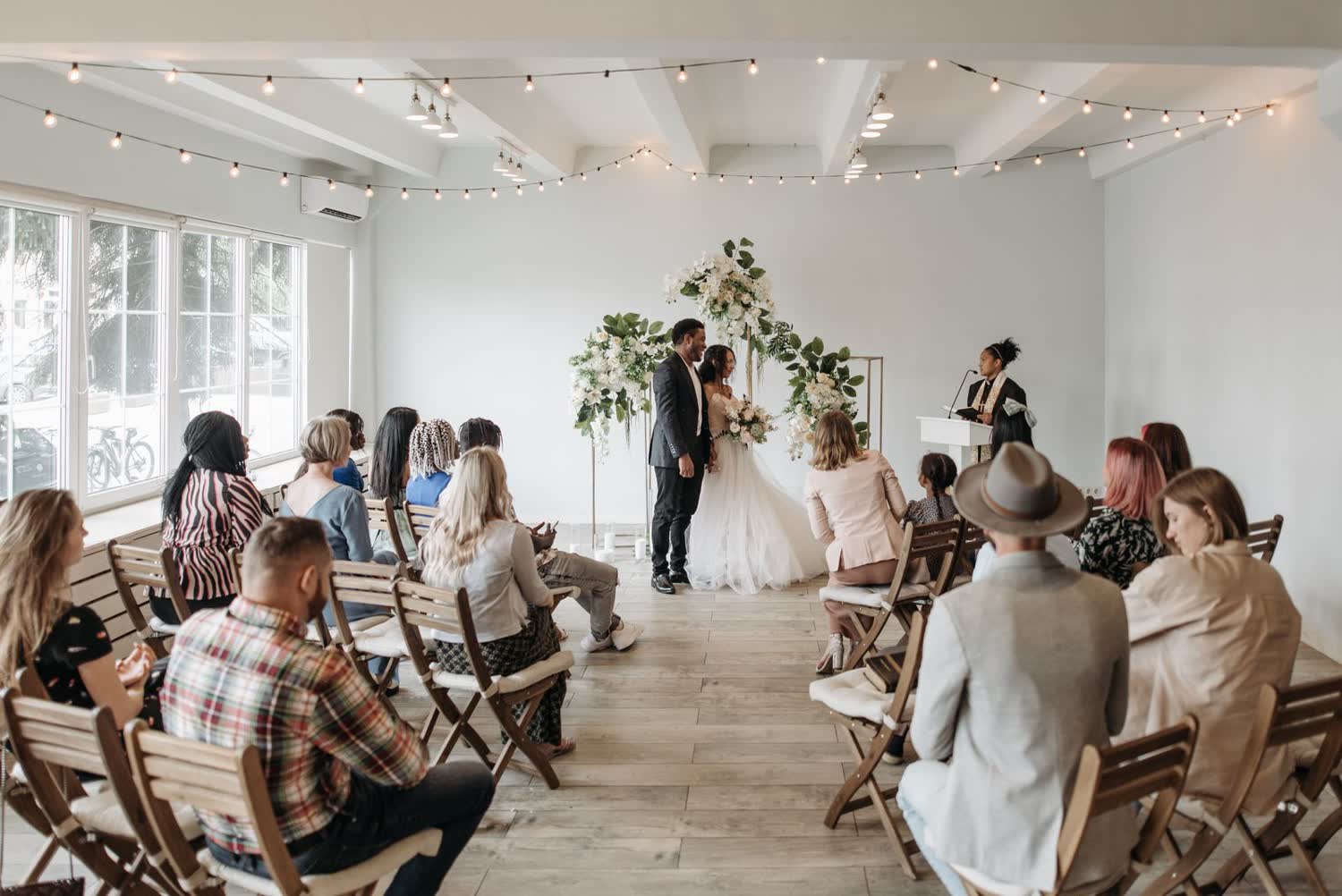
Wedding photo etiquette comes down to two separate asks pointing in opposite directions: phones down for the ceremony, phones up for the reception. A raised phone in the aisle blocks the shot you paid a professional for, while your guests at the reception are standing in the half of the day one photographer can’t cover alone. Most advice treats this as a single yes-or-no decision about going unplugged, which is why the second ask so often never gets made.
Getting both is normal and reasonable. It just needs to be asked twice, in different words, at different moments, and almost nobody tells you how to do the second one.
The ask is two asks, not one
Search “unplugged wedding” and you’ll find thousands of words on ceremony signs and officiant scripts, and close to nothing on the reception. That’s a gap in the advice, not in what couples want. Very few people who ask for an unplugged ceremony also want a reception where nobody takes a picture.
| The ask | Ceremony | Reception |
|---|---|---|
| What you want | Phones away | Phones out |
| Why | A phone in the aisle ruins the professional shot | Your photographer can’t cover every table at once |
| Who says it | Officiant, sign, invitation | MC or DJ, table cards |
| Tone | A request, made once | An invitation, repeated |
The failure mode is asking only the first one. Guests are obedient and literal: told firmly to put phones away at 2pm, a good number of them keep phones away all evening, and you end up with no candid photos of the part of the day nobody was formally shooting. Ask for the reverse explicitly, or you’ll get silence by default.
The ceremony: keep it short, say it three times
The ceremony half of this is well covered elsewhere, and The Knot’s unplugged wedding guide has more sign wording and officiant scripts than you’ll ever need. Two things worth knowing that the sign-shopping guides tend to bury:
Signs alone don’t work. A sign at the entrance gets read by people who are already looking for their seat. The version that actually lands is spoken, by the officiant, in the thirty seconds before the processional, when everyone is quiet and facing forward. If you only do one, do that one.
Say why, not just what. “Please put your phones away” reads as a rule. “We’ve asked a photographer to capture today, so please put your phones away and just be here with us” reads as an invitation, because it gives people a reason rather than an instruction. It’s also worth remembering that plenty of guests are glad to be let off the hook: being told not to document something removes an obligation they may not have wanted in the first place.
The reception: the ask nobody scripts for you
The reception ask has to overcome the ceremony ask. If your officiant just told 120 people to put their phones away, the reception prompt needs to explicitly release them, not just quietly permit it. Something like: “Phones away for the ceremony was for us. Phones out for the rest of the night is for everyone. If you get a good one, add it to the album.”
Three things decide whether it works:
- Who says it. The MC or DJ, not a sign. A sign at a reception competes with food, drink, and conversation, and loses to all three.
- When. Once early, when guests are seated and have nothing to do yet, and once more later when the dancing starts. Two prompts tend to land better than one, and more than two starts to feel like being nagged at a party.
- What you’re asking for specifically. “Take photos” is vague enough to be ignored. “We won’t see the dance floor from the top table, so if you get a good one, add it” tells people what’s actually missing and gives them a job.
If you’re collecting those photos somewhere, the mechanics of that (where the code goes, what size, how to test it) are a separate problem covered in the QR code for wedding photos setup guide. This section is only about the wording.
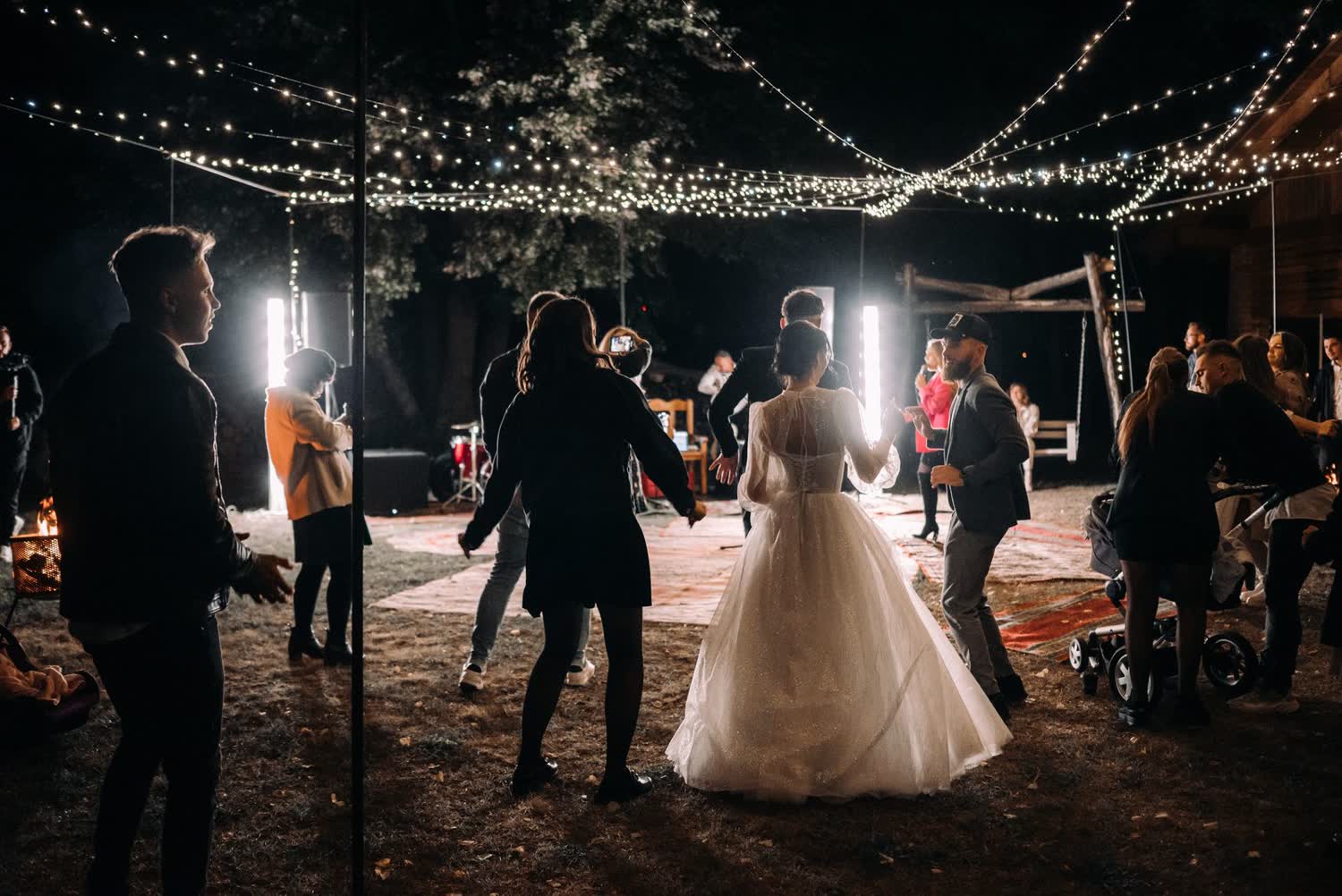
This is the footage that only exists if somebody asked for it. Nobody at the top table can see this, and the professional is usually shooting from the other side of the room.
The reception moments where the ask changes again
Not every part of the evening wants the same thing.
| Moment | What you actually want | Worth saying out loud |
|---|---|---|
| Grand entrance | Phones up, but from seats | People stepping into the aisle here causes the same problem as at the ceremony |
| Speeches | Filmed, by someone | A common regret, and the professional may be shooting stills rather than video |
| First dance | A few, then put down | A ring of raised phones is a frequent complaint couples have about their own first dance photos |
| Cake cutting | Anything | Short, well lit, hard to get wrong |
| Dancing | As much as possible | Nobody official is shooting this, and it’s the part you’ll want most |
| Late night | Judgement | “Anything after midnight, maybe keep that one between us” |

The speeches one is worth acting on specifically. If nobody is assigned, three people film the first thirty seconds on portrait video and stop, and you end up with no complete recording of the best man’s speech. Ask one person in advance to film each speech end to end, and it’s solved.
Three things guests get wrong, and are never told
None of these are rudeness. They’re all people trying to be helpful without knowing the constraints.
Stepping into the aisle. A common way a guest ruins a professional photo is leaning out for their own version of it. The processional shot has one angle and one take. Worth a specific mention rather than a general “be considerate,” because most people genuinely don’t know the photographer is locked to that line.
Flash. A guest flash fires at the wrong moment and blows out the professional’s exposure, and in a dim ceremony space it’s the difference between a usable frame and a lost one. Nobody thinks of this because phones fire flash automatically in low light.
Standing in front of the professional. Photographers work around guests constantly and rarely say anything, because asking a guest to move is awkward and reflects on the couple. If you want one line in your ceremony ask that does the most work, it’s a friendly “our photographer will be moving around, so if you find yourself in front of her, she’ll be too polite to say so.”
Photographing other people: children, and guests who’d rather not be
This is where etiquette stops being about your photos and starts being about other people’s boundaries, and it’s rarely covered in guides on the topic.
Children who aren’t yours. Some parents are relaxed about it and some are firmly not, and a wedding is exactly the setting where a guest will photograph a table of kids without thinking and post it that night. You can’t police this, and you shouldn’t try. What works is one line wherever you make the reception ask: “Please check with parents before posting photos with other people’s children in them.” It’s short, nobody argues with it, and it prevents the specific conversation you don’t want to have the next morning.
Guests who don’t want to be photographed. It happens, for reasons that are nobody’s business: a job, an ex, a health thing, or just not wanting to be. If someone tells you, tell your photographer, because they can work around one person easily if they know and not at all if they don’t. If a guest asks you to take something down later, take it down without asking why.
A shared album makes both of these easier, not harder. A photo in a private album that only invited guests can open is a much smaller ask than a photo on a public feed. Worth saying out loud when someone hesitates: “It’s not going anywhere public, it’s just for the people who were there.”
Posting: who gets to go first
The convention, and it is only a convention, is that the couple posts first. It’s worth stating because guests generally want to respect it and have no way of knowing your preference.
The version that works is specific and unbothered: “Post whatever you like, we’d just love to share the first one ourselves, so give us until Sunday.” A deadline turns an open-ended restraint into a small favour, which is much easier to honour than a vague request not to post.
Two situations worth a sentence of thought in advance. If the ceremony was unplugged, some guests will assume the whole day is off limits and post nothing at all; if you want the reception photos shared, say so. And if anything about the day isn’t public knowledge yet, a pregnancy, a job change, someone’s relationship, decide before the day rather than after, because a wedding is a room full of people who know each other and a phone is faster than any conversation you’ll have.
What you owe your guests back
Etiquette in this direction gets discussed constantly and the other direction almost never, so briefly: if you ask 120 people to put their phones away, then to take them out, then to upload what they took, you have taken up their attention several times over the course of your wedding.
The reciprocal is that they get to see the results. Send something back, reasonably soon, to everyone you asked. It doesn’t need to be the full gallery and it doesn’t need to be fast. It needs to exist, because the alternative is that a guest who did exactly what you asked never sees a single photo from the day, which is a strange thing to happen and quietly common. The reason it happens is almost always timing rather than intent, and sending photos back in waves is the fix: the first one goes out the morning after, from photos that already exist. Where those photos land matters too, because a group chat and a dedicated photo app give you very different odds of still having them next year.
Don’t correct anyone publicly, either. If a guest posts something you’d rather they hadn’t, message them. The one thing guaranteed to make a wedding photo situation worse is handling it in a comment thread.
The same asymmetry shows up at the guest book table, incidentally. Guests are asked to write something and are told nothing about what a good entry looks like, then feel bad about the one they left. One line of guidance on the first page fixes it, which is covered alongside the message examples in what to write in a wedding guest book.
Quick answers
Is it rude to ask guests not to take photos at a wedding? No. It’s a normal request and most guests welcome it, because it removes an obligation to document rather than watch. Give a reason when you ask, and keep it to the ceremony rather than the whole day.
Should guests take photos during the wedding ceremony? Only if the couple has said it’s fine. Assume not by default: stay in your seat, don’t lean into the aisle, and turn your flash off. The professional has one chance at the processional and a raised phone can cost them the shot.
How do I ask guests to take photos at the reception? Have the MC or DJ say it out loud, twice, and be specific about what’s missing. “We won’t see the dance floor from the top table, so if you get a good one, add it” works far better than a sign asking people to take photos.
Can wedding guests post photos on social media? Usually yes, but most couples prefer to post first. State a time rather than a rule (“give us until Sunday”), which is much easier for guests to honour than an open-ended request.
Is it okay to photograph other people’s children at a wedding? Taking the photo is generally fine; posting it publicly is where people object. Check with the parents before anything goes on a public feed, and treat a private shared album as a different and much lower-stakes thing.
What if a guest doesn’t want to be in any photos? Tell your photographer, who can work around one person easily if they know in advance. If someone asks for a photo to be removed afterwards, remove it without requiring an explanation.
The wording, all in one place
| Moment | Who says it | What to say |
|---|---|---|
| Invitation or website | You, in writing | “We’re having an unplugged ceremony” plus one line of why |
| Just before the processional | Officiant | The one that matters. Ask, give the reason, mention the photographer moving around |
| Start of the reception | MC or DJ | Release them from the ceremony ask, name what’s missing |
| Later, as dancing starts | MC or DJ | Same ask, shorter, once |
| Wherever you collect photos | Table card | One line on checking with parents before posting kids |
| The week after | You | Send something back to everyone you asked |
Ask twice, in opposite directions, and give a reason both times. That’s most of it.