Digital Order of Service: What Goes on Phones and What Stays on Paper

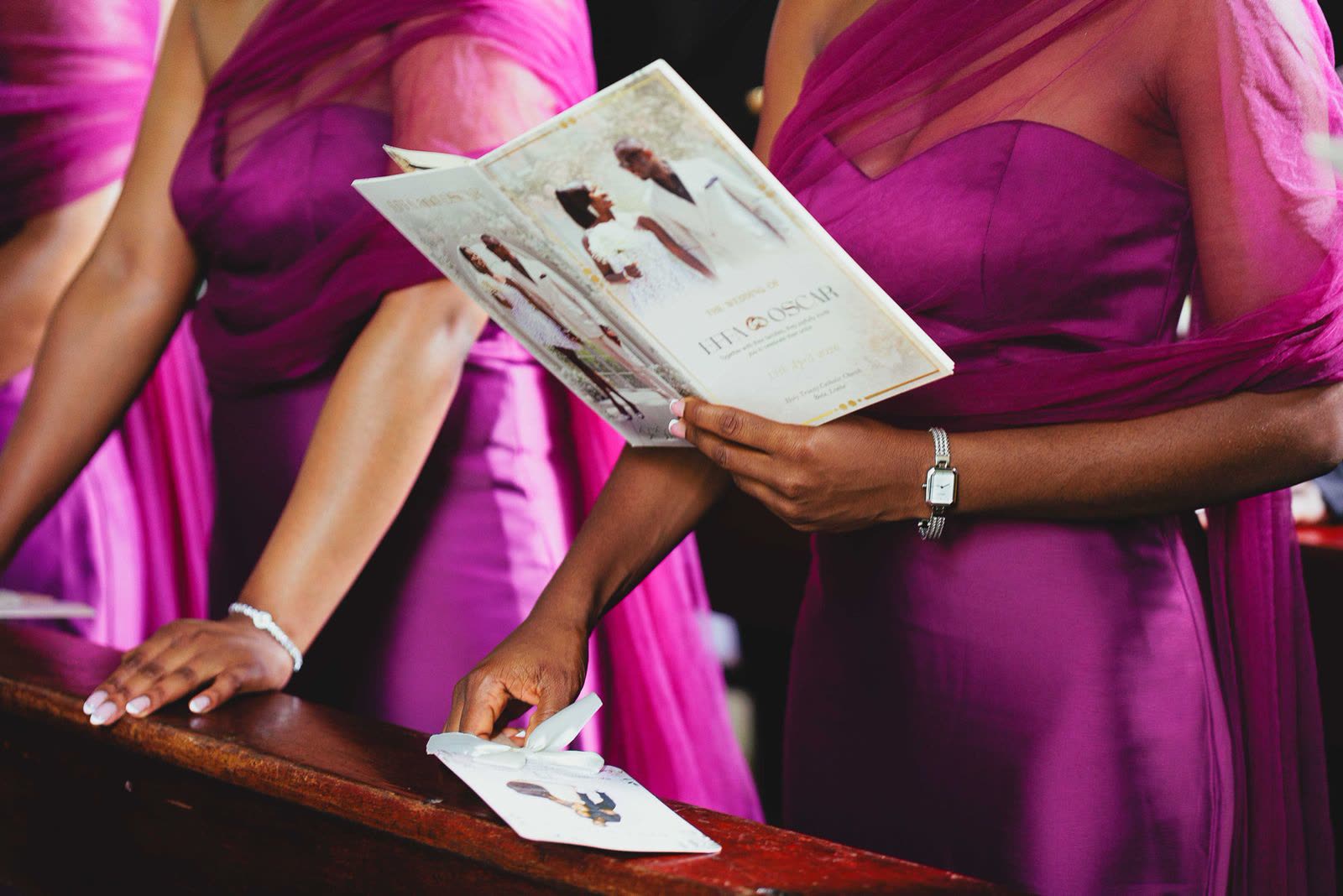
A digital order of service is a web page guests open on their phones, usually from a QR code or a link sent before the day, that sets out the running order of your wedding. It works well for everything that happens after the vows: timings, locations, what’s next and where to be. It works badly for the ceremony itself, which is the part of the day you want phones away and guests reading the words to a hymn or a response.
So for most UK weddings the honest answer is to split it. Keep a short printed order of service for the ceremony, and put the rest of the day on a page guests already have on their phones. Here is why, what the rules say about the words you print, and what each option costs.
What an order of service is actually for
An order of service is not a legal requirement for any kind of UK ceremony. Bridebook’s guide says as much, and suggests a very short civil ceremony with no music or readings probably doesn’t need one at all.
When you do have one, it does three jobs:
- It lets guests join in. Words to hymns, responses and any song the room is expected to sing. This is the job that matters most in a church.
- It tells guests who’s who. Your officiant, readers and musicians, and what each reading is.
- It’s a keepsake. Plenty of guests take theirs home, and you will want a few for yourselves.
A phone does the second job perfectly well. It does the first job badly, and it can’t do the third at all. That is the whole case for splitting the two.
The ceremony is the one part of the day you want phones away
If you are planning an unplugged ceremony, a digital order of service asks every guest to take out the exact device you’ve just asked them to put away. Once a phone is in someone’s hand for the second hymn, it’s in their hand for the vows too. (Our guide to wedding photo etiquette covers how to ask guests to put phones away and actually have it work.)
There are practical reasons too. Singing from a phone means holding a screen that dims, scrolling at the wrong moment and reading small text in low light. A folded card doesn’t run out of battery. And signal inside some churches and rural venues is patchy, so check yours on a visit before you trust a page to load on the day.
Here is how each part of a typical order of service splits:
| What goes in it | Paper or phone | Why |
|---|---|---|
| Hymn and song words, responses | Paper | Guests read them during the ceremony, hands free of phones |
| Readers, readings and music titles | Paper (phone copy optional) | Guests glance at them as each one starts |
| Welcome note and thank-yous | Either | Paper if you want a keepsake |
| Timings after the ceremony | Phone | They change, and guests need them hours later |
| Reception venue, parking, travel | Phone | A map link beats a printed address |
| Evening guests’ arrival time | Phone | Evening guests usually miss the ceremony, so they don’t get its card |
| Next-day events (brunch, barbecue) | Phone | Weekend plans shift, and paper can’t be updated |
Civil ceremonies: nothing goes to print until the registrar approves it
In England and Wales a civil ceremony can include readings, songs and music, but nothing religious, which GOV.UK spells out as no hymns and no readings from the Bible or the Torah. So the hymn section of an order of service simply doesn’t exist at a register office or hotel ceremony.
What does exist is an approval step. In Oxfordshire, for example, readings and personal vows must be submitted to the registrar at least four weeks before the ceremony, and traditional wording like “for better or worse, for richer or poorer” is not allowed because of its religious origin. Other councils set their own limits on how many readings you can have, so check yours.
Put those two dates together. Bridebook says to allow at least two to three weeks for personalised printed orders of service, and up to six weeks for bespoke illustrated ones. If the registrar has your readings four weeks out and asks you to swap one, a bespoke print run is already late. Ask your registrar early whether a reading will pass, before you send anything to a printer.
This is also where a digital copy helps. If a reader drops out the week before, a page can be corrected in a minute, whereas a reprint of 80 booklets can’t.
Church ceremonies: who owns the words you print
Two separate copyrights sit inside a church order of service, and couples usually only hear about one of them.
The service text. For a Church of England wedding, the Common Worship marriage service can be reproduced in a local order of service without asking permission, provided the text isn’t altered, the copies aren’t sold, the church’s name and the date of the service appear on the front, and the correct copyright acknowledgement is printed. Putting the text online is allowed for non-commercial use on similar conditions, including a link back to the Church of England site.
The hymns. Hymn and song words have their own copyright, separate from the service. Many churches hold a CCLI licence, and CCLI’s help centre says its licence covers reproducing authorised song words in an order of service as long as the copyright details are printed next to each song. Whether the same licence covers publishing the words on a public web page is a different question. Ask your vicar or parish office which licence the church holds and what it covers, rather than assuming.
This is one more reason hymn words belong on paper. The licence wording CCLI publishes speaks of printed orders of service, and we found nothing in it about public web pages, so a printed sheet is the safer assumption. (CCLI runs separate national licences, so the UK terms are the ones your church will hold.)
What a printed order of service costs in the UK
How many you need depends on whose rule you follow. Bridebook suggests one per guest plus 10 to 15% extra; Vintage Prints, a UK stationer, suggests one between two guests, plus a few spares. The average UK wedding in 2026 had 74 day guests, according to the Hitched National Wedding Survey.
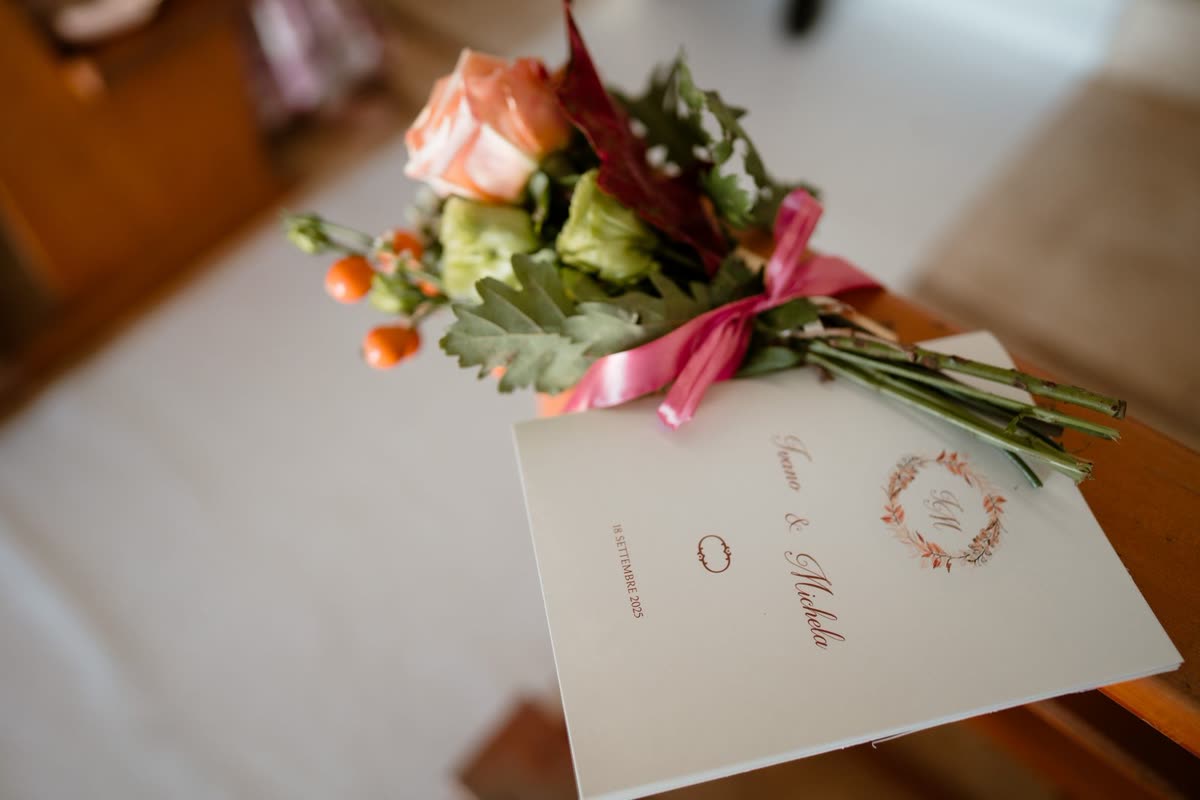
UK prices, checked October 2026, for 74 day guests:
| Option | Price | Copies needed | Rough total |
|---|---|---|---|
| Concertina card, Dotty About Paper | £2.00 to £2.75 each | 40 (one per two guests) | £80 to £110 |
| Booklet, Dotty About Paper | £2.25 to £3.50 each | 40 (one per two guests) | £90 to £140 |
| Booklet, Dotty About Paper | £2.25 to £3.50 each | 85 (one per guest plus 15%) | £190 to £300 |
| Bespoke stationer (Pemberly Fox) | Listed from £395 | Quoted per order | £395 and up |
Prices are from Dotty About Paper’s order of service range and Pemberly Fox. Some designs list a “from” price that rises with page count and finish.
The split is where the money is. A concertina card holding just the ceremony, at one between two, is the cheapest line in that table. A booklet that also carries the reception timings, the menu and the evening plan costs £0.25 to £0.75 more per copy at Dotty About Paper, and once you print one per guest the total more than doubles. Most of those extra pages are information guests will look for on their phone later anyway. (The same arithmetic applies to menus; our digital wedding menu guide covers what printed menu cards cost per guest.)
The rest of the day belongs on a page guests can find later
Once the ceremony is over, the order of service has done its job. It goes into a handbag or gets left on a pew, and the questions guests have for the next eight hours (when are the speeches, where do we park, what time are carriages) are not in it.
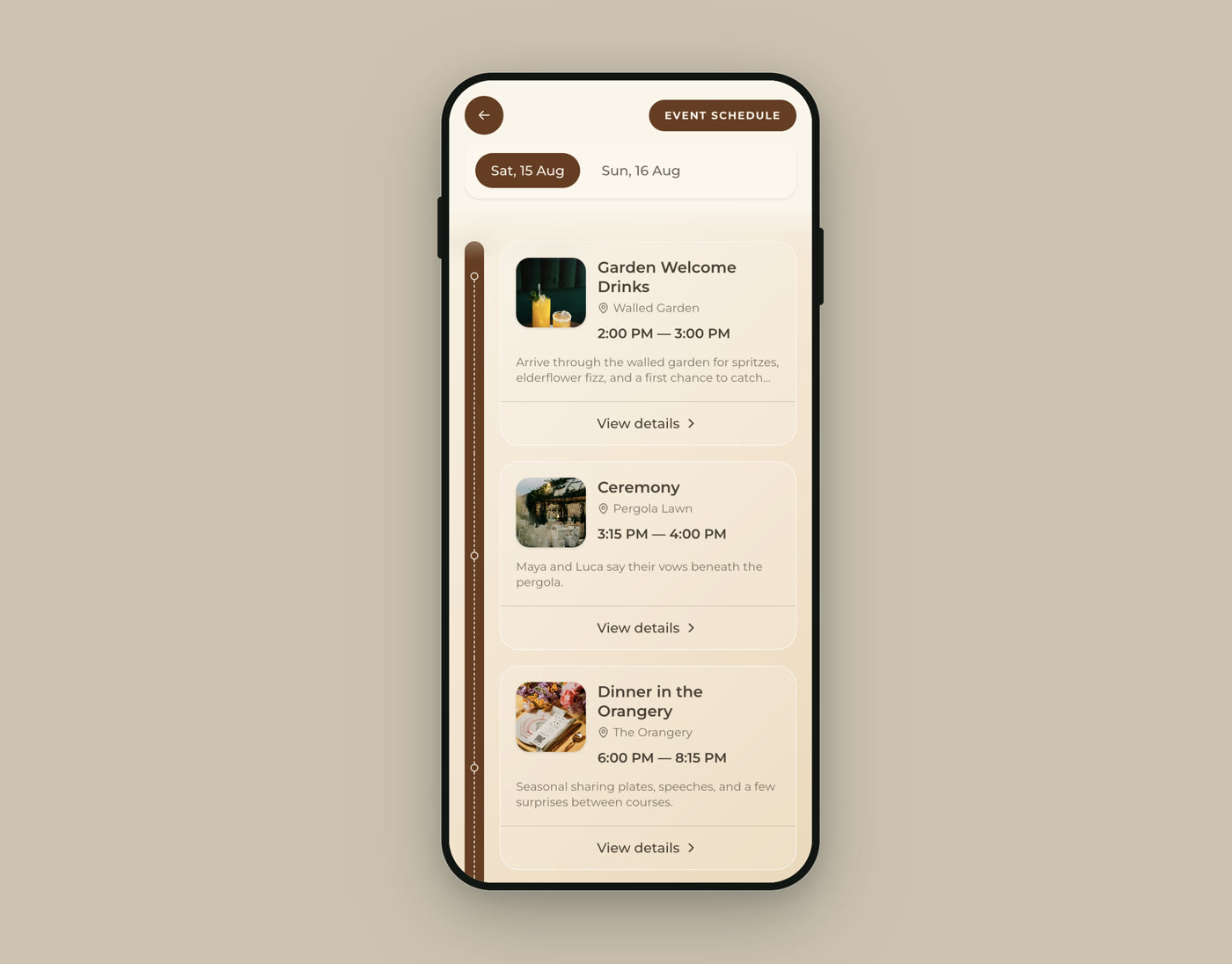
That is what a digital order of the day is good at:
- It changes. If the speeches move or the weather sends the drinks reception indoors, you edit the page and guests see the new time without reloading anything.
- It reaches evening guests. They usually missed the ceremony and its card, and they are the guests most likely to arrive at the wrong time.
- It covers a whole weekend. Welcome drinks on Friday and a Sunday brunch sit on their own day tabs instead of on an insert.
- It carries a map. Each entry can have a location that opens the guest’s maps app, which a printed address can’t do.
For what the day should actually look like hour by hour, see our UK wedding order of the day; this guide is only about where you publish it.
Setting up the split
- Write the ceremony card first. Names, date, officiant, readers, music titles and the words guests need to join in. Keep it to one folded card if you can.
- Get the readings approved before you order. Registrar for a civil ceremony, the vicar or priest for a religious one, including which hymn licence covers the print.
- Put everything after the ceremony on your event page. Times, locations, the evening plan and next-day events, with a short description on each.
- Print the link on the back of the card. One line: “The rest of the day is at” followed by the link and a small QR code. Guests turn it over at the drinks reception, which is exactly when they want it. Our QR code guide covers sizing a code that small so it still scans.
- Send the same link before the day. In the final details email or message, so guests have it before they have the card.
- Give one person the job of updating it. Usually whoever is running the day. If the timings slip, they change the page, and nobody has to walk round the room.
Quick answers
Is an order of service a legal requirement in the UK? No. It isn’t required for any type of ceremony, and a short civil ceremony with no readings or music often doesn’t need one.
Can I have hymns in a civil ceremony order of service? No. GOV.UK says a civil ceremony must not include anything religious, and gives hymns and Bible readings as examples.
How many orders of service should I print? Between one per two guests and one per guest plus 10 to 15%. For 74 day guests that is roughly 40 to 85 copies.
Can I put the order of service on a QR code instead of printing it? You can, but for a church ceremony with hymns, or an unplugged ceremony, a printed card works better. Put the QR code on the back of the card for everything after the ceremony.
Can I put hymn words on a website? Not automatically. The church’s licence covers printed orders of service; ask the church whether it also covers publishing the words online.
When should I order printed orders of service? Allow two to three weeks for personalised printing and up to six for bespoke designs, after your readings have been approved.
The checklist
| When | What to do |
|---|---|
| Ten weeks out | Choose readings and music; ask the registrar or church whether they’ll be allowed |
| Eight weeks out | Ask the church which hymn licence it holds and what it covers |
| Six weeks out | Submit readings and vows for approval (Oxfordshire asks for four weeks; check your council) |
| Five weeks out | Order the ceremony card once approval is in (bespoke designs need longer, so start those earlier); one per two guests is usually enough |
| Two weeks out | Publish the rest of the day on your event page, with times and locations |
| One week out | Send guests the link; check the page loads at the venue on mobile data |
| On the day | One named person updates the page if timings change |